

The Institute of Technical Chemistry is organized into the following research groups: WG Klemm, WG Estes, WG Traa, WG Dyballa, and WG Kurig.
For further information and the latest news from the Institute, please visit our LinkedIn page.
A detailed overview of the working groups

WG Klemm
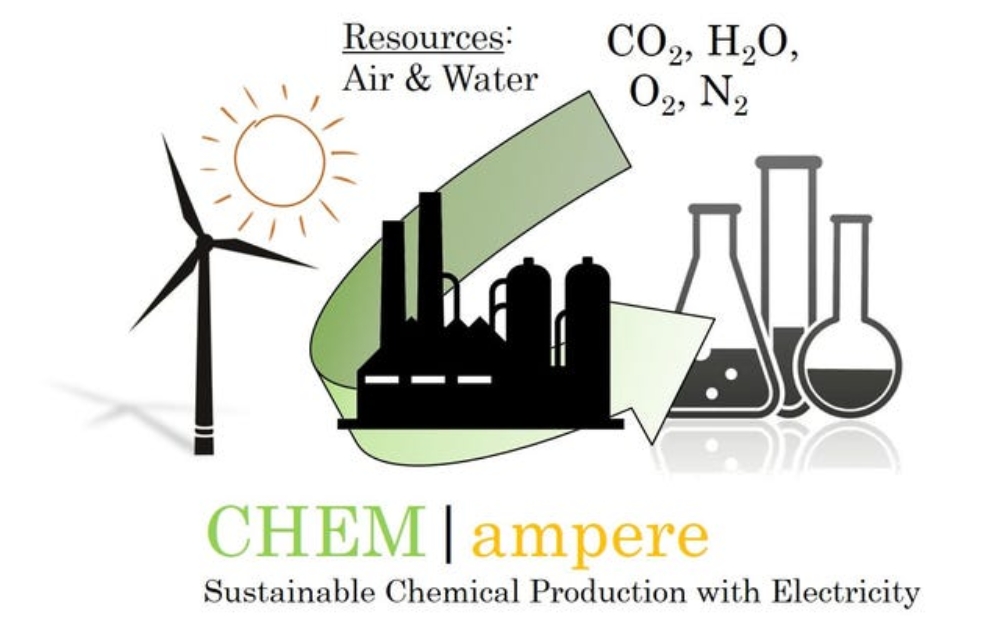
The focus of the work group of Prof. Dr.-Ing. Klemm lies in the development and optimization of chemical processes and heterogeneous catalysts. Besides more traditional thermo-catalytic processes (e.g. selective oxidation of CO using redox active oxides) and microreaction technology, the main focus is the development of sustainable processes for the chemical production as well as the usability of abundant molecules (e.g. H2O, N2, O2), greenhouse gases (e.g. CO2) or sustainable feedstocks (e.g. biogas).
As part of the Stuttgart-based research partnership CHEMampere, we are pursuing these goals with the help of the following three electricity-driven process technologies: electrocatalysis, thermocatalysis using resistively heated substrates, and plasmacatalysis.

WG Estes
In the Estes research group, the surfaces of metal oxides are modified in a targeted manner using methods from MHC and surface organometallic chemistry. In combination with homogeneous model complexes, this enables the investigation of structure-activity relationships in heterogeneous catalysis. We use these methods in particular to investigate the causes of strong metal support interactions (SMSIs), hydrogen spillover, CO2 reduction and hydrogenation, oxygen evolution reaction (OER), and surface effects in molecular heterogeneous catalysis (adsorption and confinement effects).

WG Traa
The focus of Apl. Prof. Traa's research group is on the development of materials for heterogeneous catalysis and adsorption. Zeolitic materials are mainly used, but also nanostructured, mesoporous, and specially functionalized materials as well as aluminum oxides. The main focus is on structure-activity/selectivity relationships. The main research areas encompass heterogeneous catalysis, catalyst development, and material design.

WG Dyballa
PD Dyballa's research group focuses on the synthesis of functional and, in many cases, porous solid materials and their characterization. In particular, the group investigates surface species that provide insights into the reactivity and properties of solids. The main tool used by the research group is advanced solid-state NMR spectroscopy. By combining this with infrared spectroscopy, diffraction, thermogravimetry, sorption, and catalytic application, a detailed picture of the functionalities of the solid is obtained. The group's goals are to develop new characterization methods for solids, gain a deeper understanding of adsorbed surface species, and improve catalytic properties, especially for the conversion of alcohols on zeolites.

WG Kurig
The research of Dr. Kurig's group focuses on electrochemical organic synthesis under real-world application conditions. The group is being built around a Nexus project funded by the Carl-Zeiss-Stiftung. Central to this work is the conversion of biogenic residues and waste into (fine) chemicals and liquid energy carriers. These starting materials occur as complex feed streams. The group therefore investigates not only the organic reaction network, but also the stability of electrodes in authentic reaction mixtures. A particular approach is alternating current electrolysis. It allows selectivity to be controlled in a targeted way and electrode surfaces to be regenerated during operation. Accordingly, the group develops and characterizes electrode materials and electrolysis cells tailored to such feed streams. The goal is the technical implementation of electroorganic syntheses in continuous operation.
News at the ITC
New EU Project on Direct Air Capture of Carbon Dioxide (DAC)
Prof. Dr.-Ing. Elias Klemm and apl. Prof. Dr. Yvonne Traa of the Institute of Technical Chemistry are the principal investigators of the University of Stuttgart in the project with their experience in adsorption kinetics and the tailoring of zeolitic materials. They will develop together with SINTEF the hydrophobic sorbents, which should have a higher water tolerance with stable DAC performance so that the thermal regeneration of the zeolite can be avoided in a pre-bed configuration for dehumidification. Core/shell structures with a hydrophilic core and a hydrophobic shell will be made, e.g., with mild dealumination procedures. In addition, the University of Stuttgart will in a joint activity with Johnson Matthey coat these sorbents onto electrically heatable coupons for testing. These results are later transferable to monoliths for the pilotscale testing.

Sustainable CHEMical Production with Electricity
University of Stuttgart Contributes to the eForFuel Project
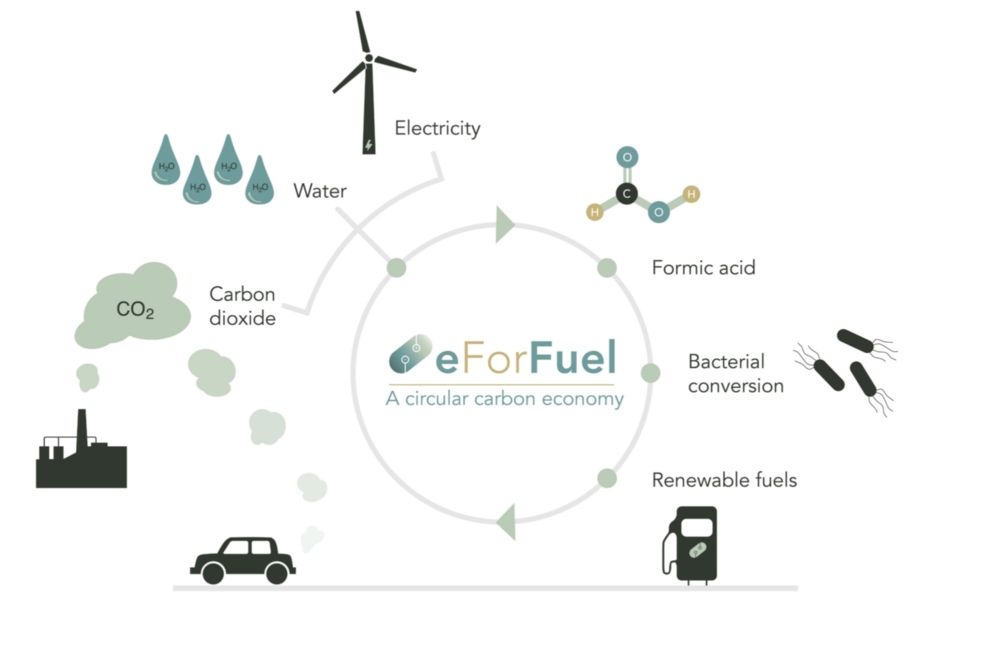
The University of Stuttgart is participating in eForFuel, an exciting EU-funded research and innovation project that aims to develop sustainable alternatives to fossil fuels by harnessing electricity and microorganisms to convert CO₂ into renewable fuels.
The ITC as Part of the SFB 1333
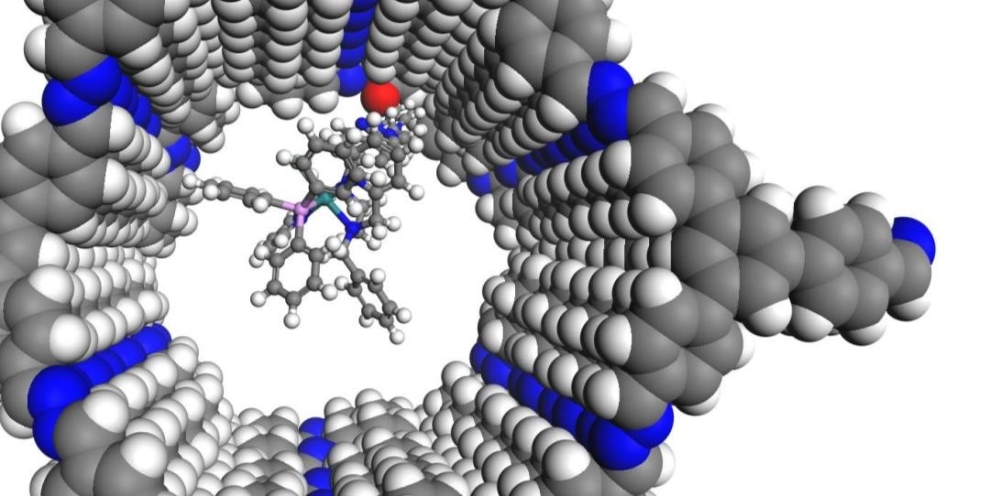
Since July 2022, the second funding period of Collaborative Research Centre (CRC) 1333 “Molecular Heterogeneous Catalysis in Defined, Confined Geometries” has been underway at the University of Stuttgart. The Estes group and the Klemm group at the Institute of Technical Chemistry (ITC) are involved in CRC 1333 with three different subprojects.
Within these projects, researchers investigate how porous support materials with defined, confining geometries influence the activity and selectivity of electrocatalytic and thermal CO₂ reduction, and how these materials affect the association of precatalysts.
Open Position at the ITC
Chemical Technical Assistant (CTA) (100% FTE, TV-L E9) (m/f/d)
As part of the Collaborative Research Centre (CRC) 1333 – Molecular Heterogeneous Catalysis in Confined Geometries, the Institute of Technical Chemistry (Prof. Dr. Estes) at the University of Stuttgart, Stuttgart-Vaihingen Campus, is seeking to appoint a Chemical Laboratory Technician (CTA) (m/f/d) at the earliest possible date.
Contact

Elias Klemm
Prof. Dr.-Ing.Director, Group Leader

Deven Estes
Prof.Dr.Director, Group Leader
Claudia Oppong Peprah
Executive Assisstant